The Equity Transition Framework™

A financial planning process built around company stock

The Equity Transition Framework™ turns a complicated set of grants, taxes, deadlines, and investment decisions into four defined phases.

You know what we are working on. You know why it matters. And you know what comes next.

The four phases

Every client works through the same four phases. The decisions inside each one are specific to you.

Phase 01

Equity mapping

Know what you actually own. We begin by documenting the entire equity picture, then map the rest of your financial life around it: cash, brokerage accounts, retirement plans, debt, spending, insurance, estate documents, and upcoming goals.

  • RSUs
  • ISOs
  • NSOs
  • ESPPs
  • Restricted stock
  • Private-company shares
  • Exercise prices
  • Cost basis
  • Vesting schedules
  • Holding periods
  • Blackout windows
  • Lockups
  • Existing 10b5-1 plans

The output: a written equity map and decision calendar.
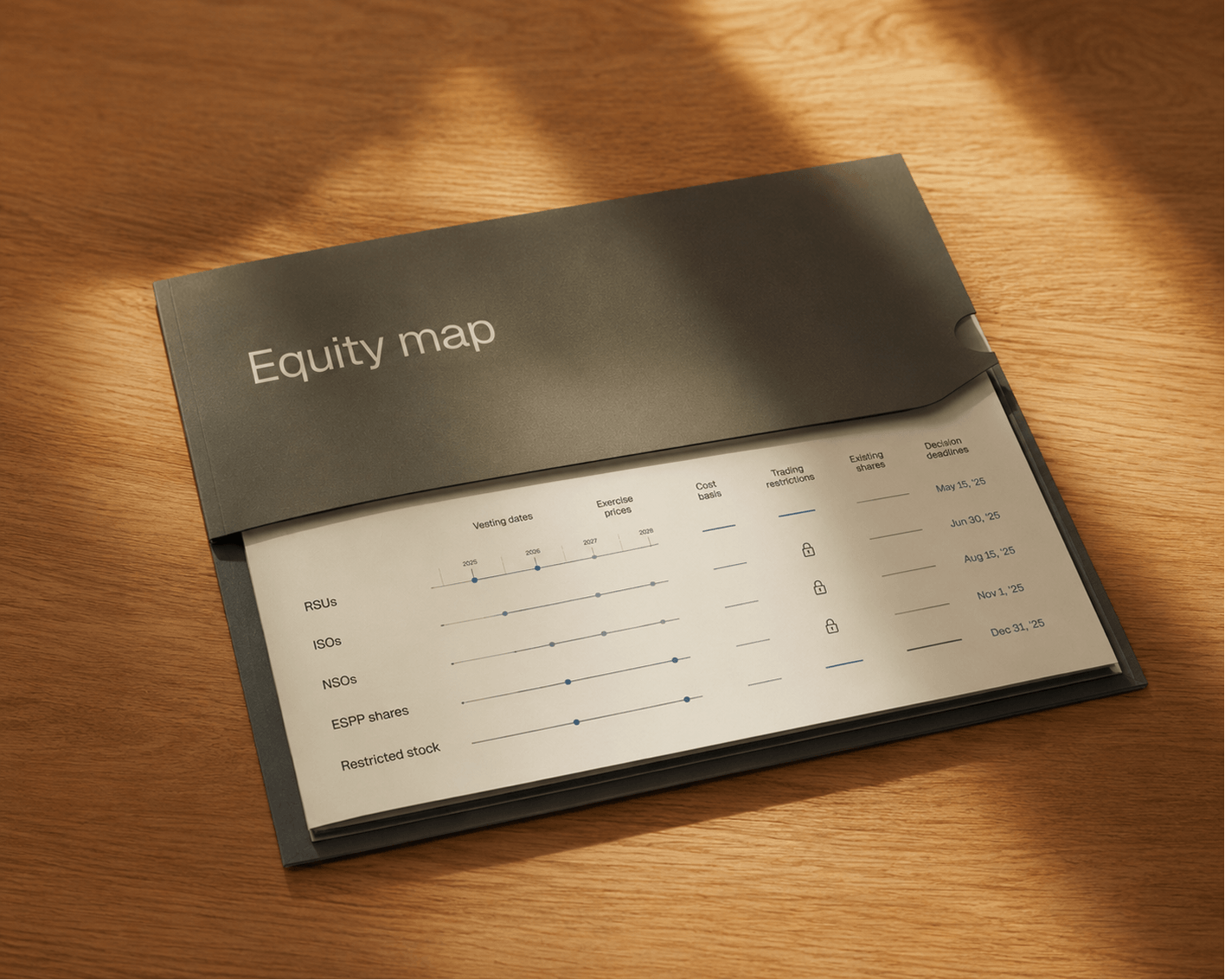
A written equity map documenting grants, vesting dates and cost basis
Phase 02

Tax opportunity analysis

Make the decision while there is still a decision to make. We evaluate the tax consequences surrounding your grants before transactions occur, then coordinate the assumptions and proposed decisions with your CPA.

  • ISO exercise modeling
  • AMT crossover analysis
  • AMT credit planning
  • Qualifying dispositions
  • ESPP tax treatment
  • Capital-gain realization
  • Charitable giving
  • Donor-advised funds
  • Tax-loss harvesting
  • QSBS eligibility
  • Multi-year sale scenarios
  • Estimated tax payments

The output: a forward-looking tax model and decision schedule.

A tax projection worksheet modelling AMT exposure and exercise scenarios
Phase 03

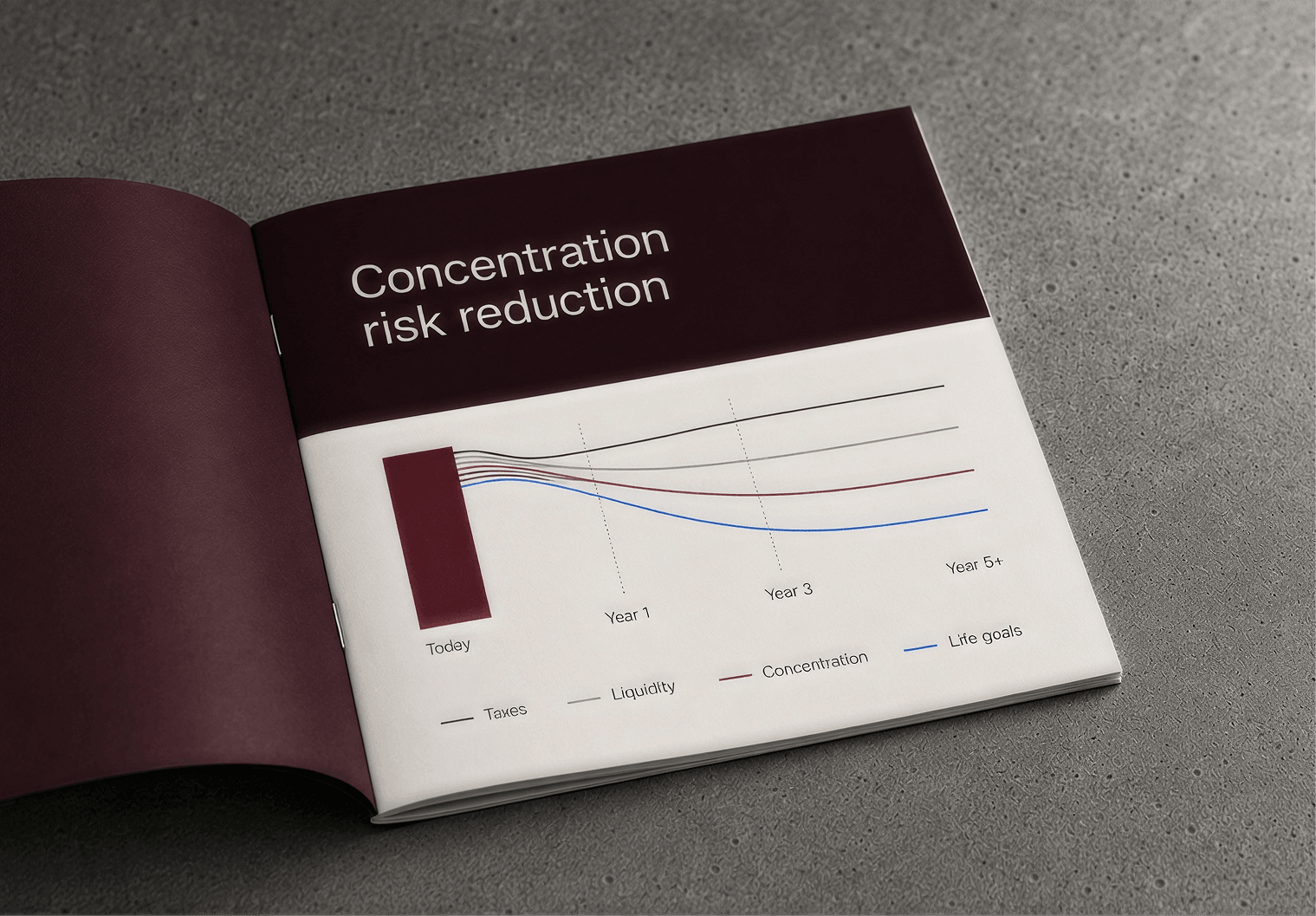
Concentration risk reduction

Stop making the same sell-or-hold decision every quarter. We define how much concentration your financial plan can support and build a process for moving toward that range.

We do not build the schedule around a prediction of where the stock will trade next. Diversification is a risk-management decision.

  • Tax lots
  • Gain realization
  • Blackout periods
  • 10b5-1 plans
  • Charitable transfers
  • Upcoming spending
  • Liquidity needs
  • Retirement timing
  • Tolerance for concentration

The output: a written diversification schedule with dates, thresholds, and tax scenarios.

A diversification schedule charting concentration reduction over time
Phase 04

Financial independence design

Decide what the wealth is for. Once the concentration is moving in the right direction, the question becomes larger: what would need to be true for you to leave your current role? How much spending should the portfolio support? How should healthcare work before Medicare? What should your estate plan look like now?

The output: a long-term plan connecting your portfolio and remaining equity to the life they are meant to support.

A financial independence plan projecting portfolio withdrawals

Getting started

What happens during the first 90 days

Most new clients spend their first 90 days primarily in Equity Mapping and Tax Opportunity Analysis. After that, the relationship moves into an ongoing quarterly rhythm, with extra conversations whenever the calendar requires them.

  1. 01 Collect and organize the equity-compensation data.
  2. 02 Build the first version of your financial plan.
  3. 03 Identify the decisions with actual deadlines.
  4. 04 Model the tax consequences.
  5. 05 Connect with your CPA.
  6. 06 Establish the initial diversification range and schedule.
  7. 07 Document the next actions and owners.

How we invest

Three commitments that shape every portfolio

Evidence over prediction

Outside your concentrated company position, portfolios generally use low-cost, broadly diversified investments. We do not try to replace your employer stock with a new set of individual-stock bets.

Tax-aware by design

Asset location, gain realization, charitable transfers, and withdrawal sequencing can materially change what you keep after tax. We evaluate the portfolio in after-tax terms.

Diversification on a schedule

We do not ask the market to tell us when your financial life has become too concentrated. The schedule is driven by your plan.

What we believe

  • A great company can still be a bad concentrated position.
  • Diversification is a risk-management decision, not a market-timing decision.
  • Waiting for the perfect time to diversify is often an expensive decision.
  • Financial independence usually happens gradually.
  • The tax return should confirm the plan, not reveal it.

Book a discovery call

Talk with Sarah about your situation

Thirty minutes on what you own, the decisions in front of you, and which phase of the framework you would start in.

Sarah Mitchell, Founder of Equipath Wealth Partners

Sarah Mitchell, CFP®, CEPA®

Founder, Equipath Wealth Partners

The Monthly Equity Comp Report

Sign up to receive our monthly newsletter on equity compensation planning, tax strategy coordination, and financial independence planning.