

Who we serve

Financial planning for people whose compensation became a balance-sheet problem

You spent years building a career. Then the equity started compounding. Now a large percentage of your wealth may depend on one company, your tax return is materially more complicated than it used to be, and decisions you once postponed are becoming too expensive to keep postponing.

That is the financial life we built Equipath around.

An advisor and client reviewing an equity plan together

The profile

Our clients tend to have a few things in common

You are likely

  • Senior in a technology company

    A director, VP, senior engineer, product leader, senior individual contributor, or executive, 8 to 25 years into the career.

  • Public, recently public, or late-stage private

    The company stage changes which decisions are urgent and which can wait.

  • Paid materially in equity

    A meaningful share of compensation arrives as RSUs, options, or restricted stock rather than salary.

  • $1M–$10M in investable assets

    With a meaningful percentage of that wealth sitting in one company.

  • Coordinating more moving parts than there is time for

    Employer, investment portfolio, tax return, and an eventual exit from full-time work, all at once.

See if we are a fit
Advisors walking through the office

Four situations we see often

Four moments where equity decisions matter most

01

The long-tenured employee

You joined years ago. The company performed well. Grants accumulated. Some shares have a very low cost basis. New RSUs continue to vest.

You have known for several years that diversification should happen. Every time you consider selling, one thought gets in the way: what if I finally sell right before it goes higher?

We replace that recurring decision with a written schedule.
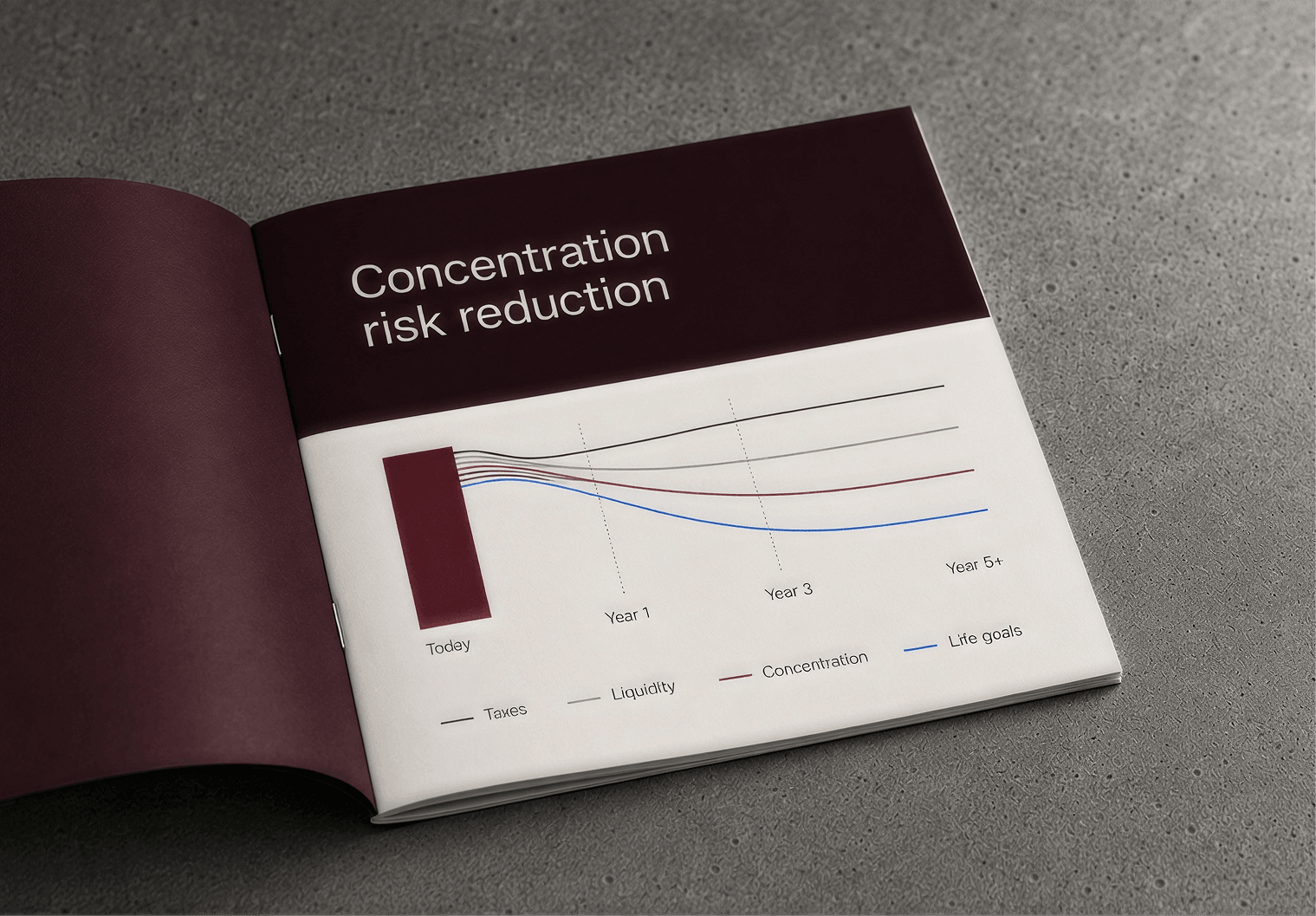
A diversification schedule charting concentration reduction over time
02

The recently IPO'd executive

Your private-company compensation suddenly became public-market wealth.

Now there are lockups, trading windows, 10b5-1 plans, tax consequences, media coverage, and a stock price you can check every three minutes. Everyone has an opinion.

We turn the event into a multi-year plan, not a sequence of isolated decisions.

Advisors walking through the office
03

The late-stage pre-IPO employee

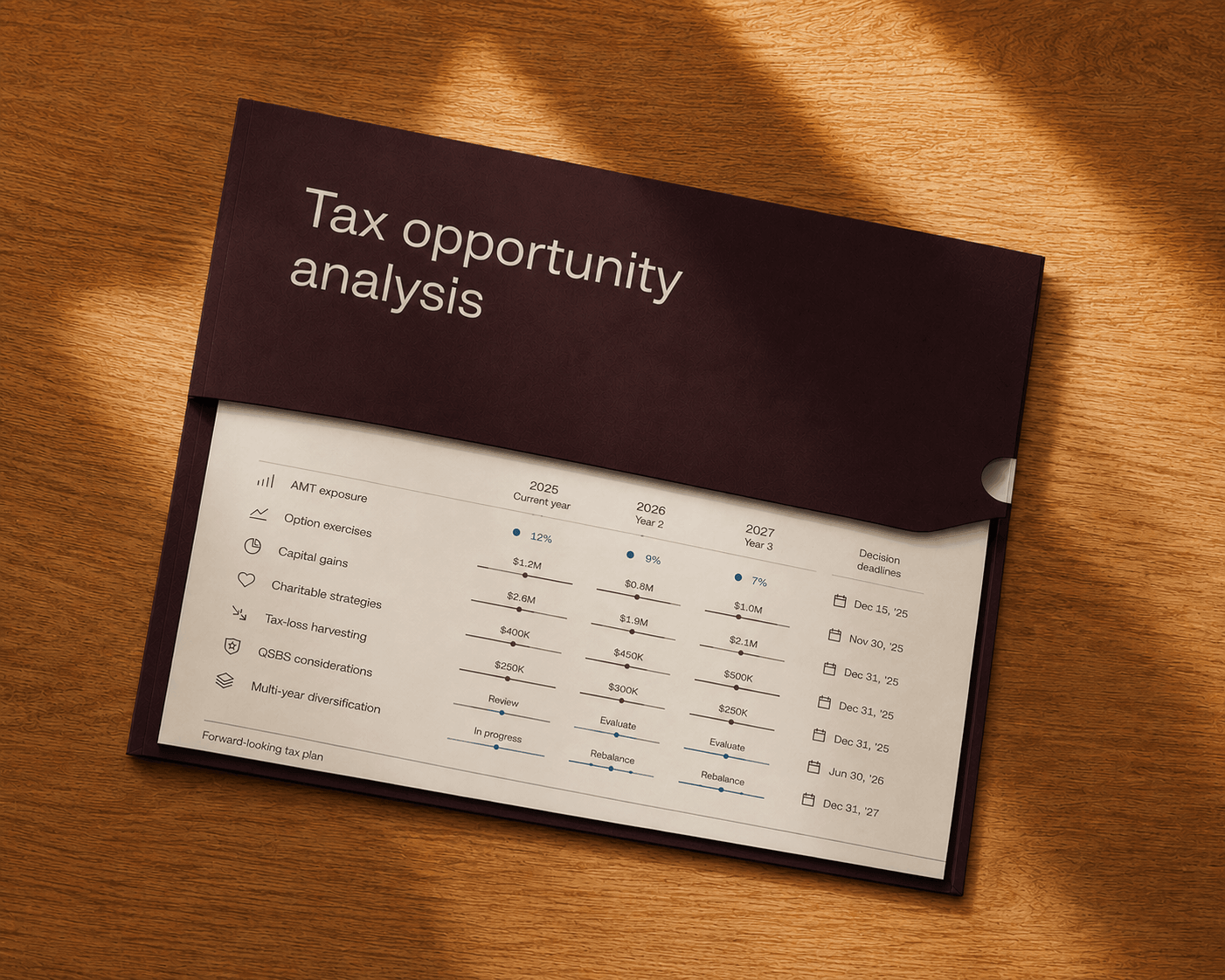
A meaningful liquidity event is plausible, but the money is still mostly on paper. That makes the decisions before the event especially important.

  • Exercise timing
  • AMT
  • 83(b)
  • QSBS eligibility
  • Cash to exercise
  • Tax before liquidity

This is the time to build the plan, while there is still room to make choices.

A tax projection worksheet modelling AMT exposure and exercise scenarios
04

The post-exit rebuilder

The job ended, the company sold, or you decided you were done. Now the question has changed.

You spent years accumulating assets. You need those assets to support several decades of life without relying on the compensation package that built them.

We model spending, withdrawals, healthcare, taxes, estate, and what role work plays next.

A financial independence plan projecting portfolio withdrawals

Fit

We would rather be clear than be everywhere

We are probably a fit when

  • Equity compensation is one of the largest items on your balance sheet.
  • Your investable assets are at least $1 million.
  • You want a primary planning relationship rather than a second opinion.
  • You want help making decisions, not predicting stocks.
  • You are comfortable reducing concentration over time.
  • You want your advisor and CPA communicating directly.
  • You care about the after-tax outcome more than winning every individual tax decision.
  • You want a plan your spouse can understand without learning the vocabulary of your compensation plan.

We are probably not a fit when

You want someone to manage a portfolio and leave everything else alone

Planning is the primary work here. Investment management is one part of it.

You actively trade individual stocks

Our portfolios use low-cost, broadly diversified investments. We do not replace one collection of stock bets with another.

Your main concern is outperforming an index

We spend much more time discussing concentration, taxes, financial independence, and the decisions under your control.

You want a one-time second opinion

Equipath is built around an ongoing primary-advisor relationship.

Common triggers

The events that tend to start the conversation

You do not need to wait for one of these — but many clients call us when one arrives.

  • 01 An IPO is announced
  • 02 A lockup period is ending
  • 03 A large vest is approaching
  • 04 An exercise decision needs to be made
  • 05 An unexpected AMT bill arrives
  • 06 A coworker is laid off
  • 07 They are considering leaving their company
  • 08 Retirement suddenly feels possible
  • 09 They buy a house
  • 10 Their estate has grown well beyond the documents they signed ten years ago
  • 11 Their spouse asks a very reasonable question they cannot answer simply

The best time to build the plan is usually before the event becomes urgent.

Book a discovery call

Start with the stock decision you keep postponing

A 30-minute conversation about what you own, the decisions in front of you, and whether Equipath is the right firm to help.

No presentation. No pressure.

Sarah Mitchell, Founder of Equipath Wealth Partners

Sarah Mitchell, CFP®, CEPA®

Founder, Equipath Wealth Partners

The Monthly Equity Comp Report

Sign up to receive our monthly newsletter on equity compensation planning, tax strategy coordination, and financial independence planning.